






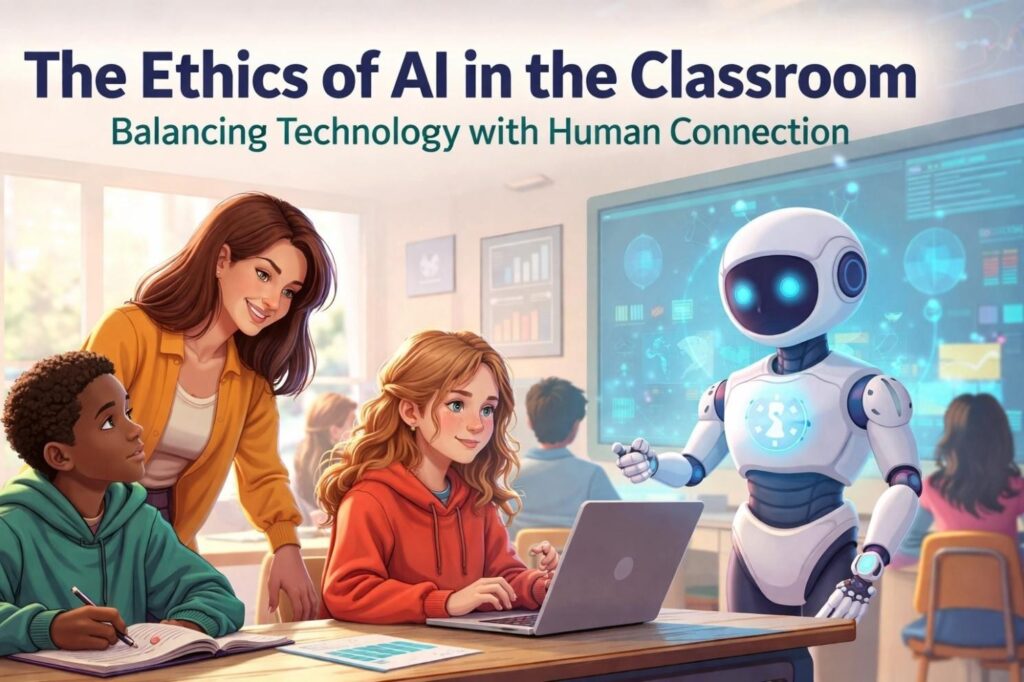
Artificial intelligence has officially arrived in our classrooms. Whether it’s ChatGPT helping students brainstorm ideas or Gemini assisting teachers with lesson planning, AI tools are changing how we teach and learn. But with this exciting technology comes a big question: How do we use these tools responsibly while keeping the human connection that our students: especially English Learners: desperately need?
This isn’t about choosing between technology and relationships. It’s about finding the balance. Let’s explore the ethical considerations every K-12 teacher should know and discover practical ways to use AI as a tool, not a replacement, for meaningful instruction.
Why This Conversation Matters Now
AI in education isn’t a future concept: it’s happening today. Students are using AI to write essays, solve math problems, and research projects. Teachers are using it to create worksheets, differentiate lessons, and save time on administrative tasks.
But here’s the thing: technology moves fast, and our ethical frameworks often struggle to keep up. According to researchers, the primary ethical concerns educators face include perpetuating systemic bias, undermining student privacy and autonomy, and amplifying existing inequities (Akgun & Greenhow, 2022).
For English Learners, these concerns are even more pressing. These students already navigate language barriers, cultural adjustments, and often trauma from displacement. They need teachers who see them as whole people: not just data points for an algorithm to analyze.

The Core Ethical Challenges
Before we can use AI well, we need to understand what we’re dealing with. Here are the key ethical issues every teacher should consider:
1. Bias in AI Systems
AI tools learn from data created by humans. That means they can inherit our biases. If an AI writing tool was trained mostly on texts written by native English speakers, it might unfairly penalize the unique linguistic patterns of multilingual students. This can reinforce harmful stereotypes rather than celebrate linguistic diversity.
2. Privacy Concerns
When students interact with AI tools, their data is being collected. What happens to that information? Who has access to it? For younger students and families who may not fully understand these implications, this raises serious concerns about informed consent (Holmes et al., 2022).
3. Equity and Access
Not all students have equal access to technology at home. If AI becomes central to learning, students without reliable internet or devices fall further behind. This digital divide disproportionately affects low-income families and recent immigrants.
4. Loss of Autonomy
When AI systems are integrated into education, students and families may have no real choice about using them. This raises concerns about human agency. Are we empowering students to learn, or are we training them to depend on machines?
5. Accuracy and Misinformation
AI can confidently present incorrect information. Educators must verify that AI-generated content is accurate before using it in instruction. Sharing inaccurate information could violate professional ethics standards (Trust et al., 2023).

Why Human Connection Cannot Be Replaced
Let’s be clear: AI cannot replace you. Here’s why this matters, especially for English Learners.
EL students are developing more than just language skills. They’re building confidence, navigating new cultural norms, and often processing difficult emotions. They need a teacher who notices when they’re struggling. They need someone who celebrates their home language as an asset, not a deficit. They need a human being who says, “I see you, and you belong here.”
No algorithm can provide that.
Research consistently shows that strong teacher-student relationships are one of the most powerful predictors of academic success. For EL students, this relationship is even more critical because it provides the emotional safety needed to take risks with a new language (Gay, 2018).
AI can help you be more efficient. It cannot help you be more human.
Practical Ways to Use AI Ethically
So how do we move forward? Here are concrete strategies for using AI tools like ChatGPT or Gemini while maintaining ethical standards and human connection.
Use AI to Differentiate, Not Replace Instruction
AI excels at creating multiple versions of the same content. Need a reading passage at three different Lexile levels? AI can help with that. Want sentence starters tailored to different proficiency levels? Ask AI for options.
This frees you up to do what AI cannot: sit with a student, listen to their thinking, and provide personalized feedback based on your relationship with them.
Example prompt for ChatGPT:
“Create three versions of a paragraph about photosynthesis: one for beginning EL students, one for intermediate, and one for advanced. Use simple sentence structures and include visual vocabulary supports for the beginning level.”

Be Transparent About AI Use
Students deserve to know when and how AI is being used in their education. Create clear classroom policies about AI. Explain what tools you’re using and why. Encourage students to share when they’ve used AI in their own work.
This transparency builds trust and teaches students to think critically about technology: a skill they’ll need for life.
Teach AI Literacy
Don’t just use AI: teach about it. Help students understand:
- How AI generates responses
- Why AI can be biased or inaccurate
- When AI is helpful versus when human judgment is better
This develops the critical thinking skills students need to navigate an AI-filled world. Students can evaluate AI-generated content to assess whether facts are accurate and arguments are sound, strengthening their analytical abilities (Akgun & Greenhow, 2022).
Protect Student Privacy
Before using any AI tool, investigate its privacy policies. Ask yourself:
- What data is being collected?
- Is it stored? For how long?
- Is it shared with third parties?
When in doubt, don’t input student names or identifying information into AI tools. Use generic examples instead.
Keep the Human Moments Sacred
Some parts of teaching should remain AI-free. Morning meetings, one-on-one reading conferences, and small group discussions are opportunities for the relationship-building that EL students need. Protect these moments fiercely.
Use AI to handle the tasks that drain your energy: formatting, brainstorming, creating templates: so you have more capacity for the moments that matter most.
Building an Ethical Framework for Your Classroom
Rather than creating rigid rules, consider developing guiding principles. Here’s a simple framework to get started:

Post these questions somewhere visible. Refer to them when making decisions about new AI tools or applications.

Moving Forward with Intention
AI in education isn’t going away. The question isn’t whether to use it, but how to use it wisely. As educators, we have the opportunity to model thoughtful, ethical technology use for our students.
For English Learners, the stakes are high. These students need both efficient, differentiated instruction and deep human connection. AI can support the first goal. Only you can provide the second.
So use the tools. Save time. Differentiate better. But never forget that your presence, your attention, and your care are the most powerful teaching tools you have.
Technology should serve our humanity: not replace it.
Dr. Marie K.
Educator | EL Advocate | Blogger
References
Akgun, S., & Greenhow, C. (2022). Artificial intelligence in education: Addressing ethical challenges in K-12 settings. AI and Ethics, 2(3), 431–440. https://doi.org/10.1007/s43681-021- 00096-7
Gay, G. (2018). Culturally responsive teaching: Theory, research, and practice (3rd ed.). Teachers College Press.
Holmes, W., Porayska-Pomsta, K., Holstein, K., Sutherland, E., Baker, T., Shum, S. B., & Koedinger, K. R. (2022). Ethics of AI in education: Towards a community-wide framework. International Journal of Artificial Intelligence in Education, 32(3), 504–526. https://doi.org/10.1007/s40593-021-00239-1
Trust, T., Whalen, J., & Mouza, C. (2023). Editorial: ChatGPT: Challenges, opportunities, and implications for teacher education. Contemporary Issues in Technology and Teacher Education, 23(1), 1–23.