







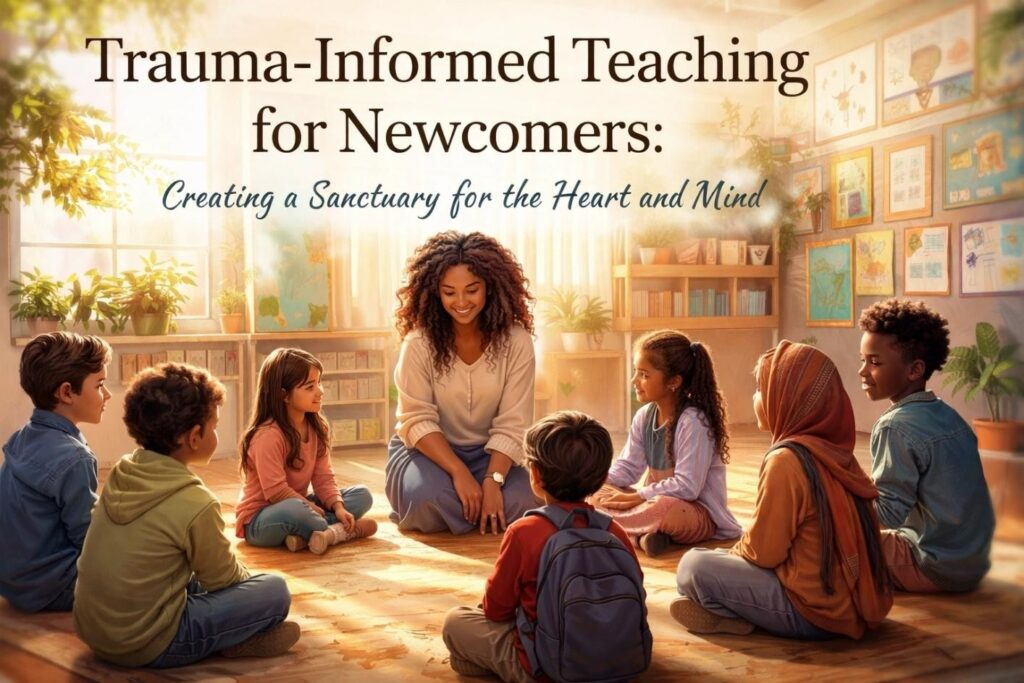
Every year, thousands of newcomer students walk through classroom doors carrying more than backpacks. They carry memories of displacement, uncertainty, and sometimes unimaginable hardship. As K-12 teachers and ESOL specialists, we often focus on language acquisition: verb tenses, vocabulary, and reading levels. But what happens when a child’s heart is too heavy to learn?
Trauma-informed teaching offers a path forward. It recognizes that before we can teach content, we must first create a sanctuary: a place where students feel safe enough to take risks, make mistakes, and grow.
This article explores practical, evidence-based strategies to help you build that sanctuary in your classroom.
What Is Trauma-Informed Teaching?
Trauma-informed teaching is an educational approach that acknowledges how adverse experiences affect a student’s emotional wellbeing and ability to learn. For newcomer students
specifically, this means understanding the unique challenges of displacement, migration trauma, and cultural adjustment.
Here’s the science behind it: when a student’s body senses threat, energy shifts away from the brain regions responsible for learning and toward those specialized in survival (American Psychological Association, 2021). A child in “fight, flight, or freeze” mode simply cannot focus on a grammar lesson.
For newcomers, this stress response may be triggered by:
- Unfamiliar environments and routines
- Language barriers that create isolation
- Memories of violence, poverty, or loss
- Separation from family members
- Fear of deportation or instability
Trauma-informed teaching doesn’t ask teachers to become therapists. Instead, it equips us with strategies to reduce triggers, build trust, and create conditions where healing and learning can happen together.

Understanding the Newcomer Experience
Newcomer immigrant youth often carry complex trauma histories. Some have experienced poverty, community violence, abuse, or neglect. Others have witnessed war or spent months in refugee camps. Many have been separated from parents, siblings, or extended family (National Child Traumatic Stress Network, 2018).
Even students who haven’t experienced overt violence face significant stress. The act of leaving everything familiar: home, friends, language, food, routines: is itself a form of loss. Add to that the pressure of adapting to a new culture while navigating an unfamiliar school system, and it’s easy to see why many newcomers struggle.
What makes this population unique is the intersection of trauma, language, and culture. A student may lack the English vocabulary to express their feelings. Cultural norms may discourage discussing emotions openly. And well-meaning teachers may misinterpret trauma responses as defiance, laziness, or learning disabilities.
Trauma-informed teaching helps us see beyond surface behaviors to the needs underneath.
Core Principles for Creating a Sanctuary
1. Safety First
The foundation of trauma-informed practice is safety: physical, social, and emotional (Cole et al., 2005).
Physical safety means organizing a clean, welcoming classroom with clear sightlines and predictable routines. Consider providing a designated “calm corner” where students can retreat when emotions feel overwhelming.
Social safety involves protecting students from bullying, exclusion, and microaggressions. It means being intentional about partner and group assignments, especially early in the year.
Emotional safety requires creating a judgment-free zone where mistakes are normalized and curiosity is celebrated. Students need to know they won’t be shamed for incorrect answers or imperfect English.
For newcomers, safety also means predictability. Post visual schedules. Give warnings before transitions. Use consistent routines so students know what to expect.
2. Culturally Responsive Approaches
Trauma-informed practices must be culturally sensitive. What feels supportive in one culture may feel intrusive or inappropriate in another.
For example, direct eye contact is considered respectful in many Western contexts but may feel threatening to students from cultures where averting one’s gaze shows respect. Similarly, asking students to share personal stories in front of the class may cause distress for those whose cultures value privacy.
Being trauma-informed means “creating safe spaces, offering culturally sensitive support, and recognizing that healing takes time” (Substance Abuse and Mental Health Services
Administration, 2014). Take time to learn about your students’ backgrounds. Partner with families and cultural liaisons. And always ask before assuming.
3. Strength-Based Thinking
It’s tempting to focus on what newcomers lack: English proficiency, grade-level content knowledge, familiarity with school norms. But this deficit-based thinking can damage self-esteem and reinforce feelings of inadequacy.
Trauma-informed teaching flips the script. Instead of asking “What’s wrong with this student?” we ask “What has this student survived? What strengths have they developed?”
Consider: a student who navigated multiple countries to reach safety has demonstrated incredible resilience. A child who serves as the family translator has developed sophisticated communication skills. A teenager who works after school to support siblings shows remarkable responsibility.
Identify these strengths. Name them. Celebrate them. Explicit, genuine praise helps rebuild self-esteem that may have been damaged by traumatic experiences (Brunzell et al., 2016).
Practical Strategies for the Classroom
Build Relationships Intentionally
Positive relationships between teachers and students are foundational for all learners: but they’re especially critical for students experiencing trauma (Cole et al., 2005). These connections signal safety and open the door to learning.
Try this:
- Greet each student by name at the door
- Learn a few words in your students’ home languages
- Find out what students are interested in and reference those interests in lessons
- Check in privately with newcomers regularly, even if just for 30 seconds
Use Restorative Rather Than Punitive Practices
Students who have experienced trauma may exhibit challenging behaviors: outbursts, withdrawal, defiance, difficulty focusing. Traditional discipline often backfires, increasing shame and damaging the student-teacher relationship.
Restorative practices view behavioral challenges as attempts to communicate unmet needs (Wachtel, 2016). Instead of punishment, try:
- One-on-one conversations to understand what happened
- Class circles to address conflicts collectively
- Natural consequences paired with problem-solving
- Emphasis on repairing harm rather than assigning blame
This approach maintains high expectations while preserving dignity and connection.

Teach Emotional Regulation Explicitly
Many newcomers have never learned vocabulary for emotions: in any language. Trauma-informed teaching helps students identify, name, and manage their feelings.
Simple strategies include:
- Posting emotion charts with pictures and labels
- Teaching breathing exercises and mindfulness techniques
- Modeling your own emotional regulation (“I’m feeling frustrated right now, so I’m going to take a deep breath”)
- Creating “toolkits” of calming strategies students can use independently
Foster a Growth Mindset
Students processing trauma often experience negative thinking patterns. They may believe they’re “stupid,” “bad,” or incapable of change. These beliefs become barriers to learning.
Counter this by explicitly teaching growth mindset principles:
- Intelligence and abilities can develop with effort
- Mistakes are opportunities for learning
- Struggle is a normal part of growth
Use encouraging language: “You haven’t mastered this yet” instead of “You got it wrong.” Celebrate progress, not just achievement.
The Evidence: Does This Work?
Yes. A 2021 literature review by the American Psychological Association found that trauma-informed programs improve academic outcomes for students with histories of childhood adversity. Students exposed to these strategies showed better emotional regulation, increased resilience, higher academic achievement, and improved attention in class.
The review identified three key factors for success:
- Clear classroom rules and expectations
- Consistent routines
- Trusting teacher-student relationships
These aren’t complicated interventions requiring expensive training. They’re accessible strategies any teacher can implement starting tomorrow.
Your Classroom as a Sanctuary
Creating a trauma-informed classroom isn’t about adding more to your already full plate. It’s about shifting perspective. It’s about seeing the whole child: heart, mind, and history: and responding with compassion and intention.
For newcomer students who have fled difficult situations, your classroom may be the most stable, predictable environment in their lives. It may be the first place where an adult believes in them unconditionally.
That’s a sacred responsibility. And it’s also a profound privilege.
Dr. Marie K.
Educator | EL Advocate | Blogger
References
American Psychological Association. (2021). Trauma-informed schools for children in K-12: A system framework. https://www.apa.org/ed/schools/trauma
Brunzell, T., Stokes, H., & Waters, L. (2016). Trauma-informed positive education: Using positive psychology to strengthen vulnerable students. Contemporary School Psychology, 20(1), 63-83.
Cole, S. F., O’Brien, J. G., Gadd, M. G., Ristuccia, J., Wallace, D. L., & Gregory, M. (2005).
Helping traumatized children learn. Massachusetts Advocates for Children.
National Child Traumatic Stress Network. (2018). Trauma-informed care for newcomer children and youth. https://www.nctsn.org
Substance Abuse and Mental Health Services Administration. (2014). SAMHSA’s concept of trauma and guidance for a trauma-informed approach. HHS Publication No. (SMA) 14-4884.
Wachtel, T. (2016). Defining restorative. International Institute for Restorative Practices.