






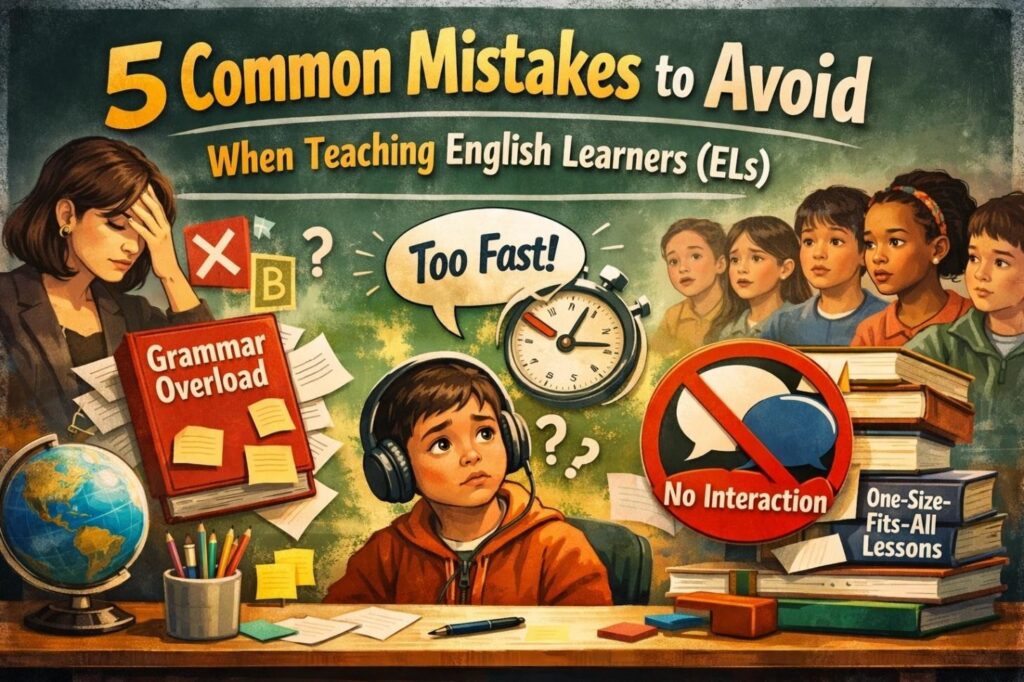
Teaching English Learners (ELs) can be one of the most rewarding aspects of education, but it also comes with unique challenges. Even well-intentioned educators sometimes fall into common traps that can hinder their students’ language development and academic progress. Understanding what not to do is just as important as knowing effective strategies.
Let’s explore five critical mistakes that educators should avoid when working with English Learners: and what to do instead.
Mistake #1: Confusing Lack of English Proficiency with Lack of Intelligence
One of the most damaging assumptions teachers can make is equating a student’s limited English skills with limited cognitive ability. Just because a student struggles to express themselves in English doesn’t mean they lack intelligence, critical thinking skills, or academic potential (García & Kleifgen, 2018).

Students who are learning English may be highly capable in their home language. They might solve complex math problems, understand sophisticated concepts, or possess advanced knowledge in various subjects; they haven’t yet developed the English vocabulary to demonstrate it.
What to do instead: Hold high expectations for all students. Provide scaffolding and support that allows ELs to access grade-level content while they’re still developing English proficiency. Use visual aids, hands-on activities, and home language resources when possible, to assess true understanding rather than just English fluency.
Mistake #2: Assuming Social Fluency Equals Academic Language Proficiency
Here’s a scenario that happens all the time: A teacher notices that an English Learner can chat easily with classmates during lunch, tell jokes, and participate in casual conversations. The teacher assumes this student has “learned English” and no longer needs language support.
This is a critical misconception. Social language (BICS: Basic Interpersonal Communication Skills) typically develops within 1-3 years, while academic language (CALP: Cognitive Academic Language Proficiency) can take 5-7 years or longer to fully develop (Cummins, 2008).

Academic language includes content-specific vocabulary, complex sentence structures, abstract concepts, and the language needed for reading textbooks, writing essays, and understanding lectures. A student might be able to say “I’m hungry” with ease but struggle with “photosynthesis” or “analyze the author’s purpose.”
What to do instead: Continue providing targeted language instruction and scaffolding even after students seem conversationally fluent. Explicitly teach academic vocabulary, provide sentence frames for writing, and use graphic organizers to support comprehension of complex texts.
Mistake #3: Delaying ELs’ Participation in Meaningful, Authentic Learning Tasks
Some educators believe they need to hold English Learners back from “real” academic work until they’ve mastered basic English. This approach isolates ELs and deprives them of the rich language input and authentic learning opportunities they desperately need (Walqui & van Lier, 2010).
Language is best acquired through meaningful use: not through worksheets in isolation. When students engage in group projects, discussions, problem-solving activities, and hands-on learning, they’re exposed to language in context, which accelerates acquisition.
What to do instead: Include ELs in substantive learning from day one. Use scaffolding strategies like:
- Visual supports and realia (real objects)
- Sentence frames and sentence starters
- Collaborative group work with strategic partner pairings
- Modeling and think-alouds
- Graphic organizers
These tools allow students to participate meaningfully while their language skills develop.
Mistake #4: Misinterpreting the Silent Period as Disengagement or Lack of Learning

Many English Learners go through what’s called a “silent period”: a stage where they listen, observe, and absorb the language without producing much spoken English themselves. This period can last weeks or even months, and it’s completely normal (Krashen, 1982).
Unfortunately, teachers sometimes misinterpret this silence as:
- Lack of engagement
- Lack of understanding
- Shyness that needs to be overcome
- A problem that requires forcing the student to speak
Pressuring students to speak before they’re ready can actually increase anxiety and slow down language acquisition.
What to do instead: Respect the silent period. Continue providing rich language input through:
- Read-alouds and storytelling
- Songs and chants
- Visual demonstrations
- Peer modeling
- Low-pressure response options (pointing, drawing, thumbs up/down)
Students are actively learning during this time: they’re just not ready to produce language yet. When they are ready, they’ll start speaking naturally.
Mistake #5: Oversimplifying Tasks or Ignoring Language Proficiency Levels
This mistake goes in two directions. Some teachers oversimplify everything for ELs, essentially “dumbing down” the curriculum and lowering expectations. Others ignore language proficiency levels entirely and expect the same output from beginners as they do from advanced speakers.
Neither approach works. ELs need access to grade-level, rigorous content, but they also need appropriate scaffolding based on their current proficiency level (WIDA, 2020).
What to do instead: Familiarize yourself with language proficiency frameworks like WIDA or ELPA21. Use “can do” descriptors to understand what students at each level can accomplish.
Then differentiate your instruction accordingly:
- Beginning level: Heavy visual support, sentence frames, word banks, partner work
- Intermediate level: Graphic organizers, paragraph frames, group discussions with structured roles
- Advanced level: Independent writing with revision support, complex texts with annotation strategies
The key is maintaining high cognitive demand while providing appropriate language support.
A Word of Caution About AI and Translation Tools
Important Disclaimer: As educators increasingly use AI tools and translation software to support English Learners, it’s important to understand their limitations. AI-generated content may not be 100% accurate because these systems can inadvertently incorporate grammar patterns, syntax, and idioms from languages other than English. What seems like perfectly translated material might contain subtle errors or culturally inappropriate expressions.
Recommendation: Always seek help from a certified translator or bilingual specialist in your district to check translated materials for accuracy before sharing them with students and families. This extra step ensures that your communication is clear, culturally appropriate, and truly supportive of your English Learners.
Moving Forward
Avoiding these five common mistakes can significantly improve your effectiveness with English Learners. Remember: these students bring valuable linguistic and cultural assets to your classroom. They’re not empty vessels waiting to be filled: they’re capable learners navigating the complex process of adding a new language to their repertoire.
By holding high expectations, understanding the differences between social and academic language, including ELs in authentic work from day one, respecting the natural stages of language acquisition, and differentiating appropriately, you’ll create a classroom environment where all students can thrive.
Dr. Marie K.
Educator | EL Advocate | Blogger
References
Cummins, J. (2008). BICS and CALP: Empirical and theoretical status of the distinction. In B. Street & N. H. Hornberger (Eds.), Encyclopedia of language and education (2nd ed., Vol. 2, pp. 71-83). Springer.
García, O., & Kleifgen, J. A. (2018). Educating emergent bilinguals: Policies, programs, and practices for English learners (2nd ed.). Teachers College Press.
Krashen, S. D. (1982). Principles and practice in second language acquisition. Pergamon Press.
Walqui, A., & van Lier, L. (2010). Scaffolding the academic success of adolescent English language learners: A pedagogy of promise. WestEd.
WIDA. (2020). WIDA English language development standards framework, 2020 edition: Kindergarten–grade 12. Board of Regents of the University of Wisconsin System.